
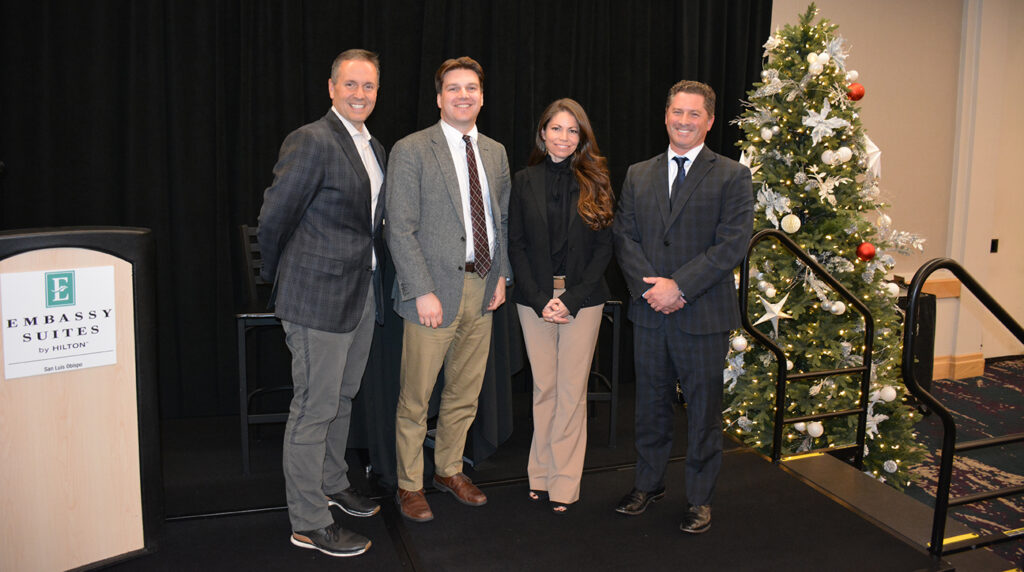
This year’s State of the State, held at Embassy Suites in San Luis Obispo, brought together nearly 200 leaders from the San Luis Obispo business community. Former Assemblymember Jordan Cunningham and CalMatters Capitol State Reporter Alexei Koseff discussed the impact of the national election for California and the Central Coast and highlighted what’s coming down the pipeline in 2025 while onstage with moderator Christine Robertson, Executive Director for the San Luis Coastal Education Foundation.
This year’s election marked a shift in voter sentiment, with many districts moving from blue to red. Alexei shared that Democrats in Sacramento have noticed an economic shift and have since begun addressing high cost of living and affordability—topics that have not traditionally been part of the Democratic agenda. The question moving forward is whether they will continue to focus on these issues and deliver results. He also suggested that the rising discontent among voters of color may have contributed to this strategy shift, particularly in response to economic concerns. Jordan agreed, emphasizing the pivot in priority to addressing issues impacting the working class, especially in California, and reminded the audience that California remains a predominantly blue state.
As the Trump administration prepares to take office, Christine asked what issues and trends might come to the forefront in California. Jordan put a strong emphasis on the need for increased collaboration with the federal government to achieve positive outcomes for our state, saying that “California needs to play the game in a positive way for positive outcomes.” He also believes that energy policy, specifically how California will meet its climate goals while ensuring reliable power, will be a top priority. However, he cautioned that policy changes will require broad, bipartisan agreement, which can be difficult to achieve in our current political climate. Alexei pointed out that Medicaid funding, infrastructure projects, the opioid epidemic, especially fentanyl, and minimum wage discussions will remain high on the agenda. He also predicted that established nationwide leaders could stall progress on some issues, as newer federal and state legislators will need time to gain influence and get things done.
When asked about the California Environmental Quality Act, or CEQA, reform, Jordan made it clear that significant change will only come if the governor is willing to push for it. Both agreed that Governor Newsom had pushed for some reforms, but not hard enough. Alexei believed that small strategic efforts could yield some success in potential reforms. Both agreed that improvements in the home insurance market are desperately needed. Premiums will likely continue rising and Governor Newsom will face pressure to address the problem.
This year, California legislators voted to limit themselves to introducing 35 bills in both the State Assembly and Senate instead of 40 and 50, respectively. Both Jordan and Alexei agreed that this change could help reduce frivolous bills and create a more focused and thoughtful legislative agenda, potentially leading to more meaningful progress.
To close out the event, Christine asked the panelists to predict the headlining issues in the coming year. Jordan identified the collapse of the homeowners’ insurance market and the need to address why it’s failing, and Alexei touched on immigration issues and the electric vehicle market as key areas to watch. Though both panelists acknowledged that “we’ll have to see what happens,” they agreed that the hope is for a future that ultimately benefits California in the long term.