
By Karen Duggan
It seems unlikely that a single solution could address a myriad of organizational problems that stem from worker overload, high-stress, disengagement, conflict and other challenging workplace relationship issues.
The truth is that mindfulness practices, which are simple to put to use, can have an incredibly wide range of benefits, including: reduced stress, increased focus, greater emotional regulation, enhanced relationships (via empathy and compassion) and improved health – both mental and physical.
Consider the A-list of organizations that have adopted mindfulness programs, including: Google, Apple, Intel, Starbucks, Aetna, Proctor & Gamble, General Mills, New Balance, Zappos, Promega Bioresearch, Bose (and the list goes on,) or the thousands of articles that can be found in the Harvard Business Review, The Wall Street Journal, Wired, Computerworld, Time, The Huffington Post and Fast Company.
Mindfulness, defined as “paying attention on purpose, in the present moment, and nonjudgmentally, to the unfolding of experience moment to moment,” can be developed by anyone, any time, by committing to a few simple practices.
3×3 Focus System: Short breaks taken periodically throughout the day, can reset our brain, literally helping us to create new neural pathways and alleviating the tendency to get into mental ‘ruts’ which can sabotage our efforts to focus on tasks at hand. The 3×3 Focus System, in its simplest form, is merely taking three 3-minute breaks a day.
TRY: Find a comfortable spot to sit – either in silence or with a 3-minute audio – and give yourself the benefit of a fresh start.
Body Scan: At any time, but especially when you notice yourself feeling ‘triggered’ in some way, take a moment to scan through your body to see what you notice. This level of acknowledgement that ‘something is up’ and the awareness of where the discomfort is in your body can provide great clues for what to do next.
TRY: Begin at the crown of your head and scan through your body slowly, ending at your feet. Are there areas where you can feel yourself holding tension or irritation? Direct attention to these spots and see if you can release the discord simply through your awareness.
One Deep Breath: Chade Meng Tan, the former Google engineer made famous for his Search Inside Yourself program, put his engineering mind to good use to find out the fastest way to a result. His conclusion: 6-seconds of your time can provide awareness, relaxation and even joy.
TRY: Pause for a moment and decide to become completely aware of exactly what is happening in the present moment on your in-breath. Relax completely on the out-breath.
Simple yet effective, these practices done alone can have great results, and when supported at the organizational level can have far-reaching impact on the workforce and the bottom line.
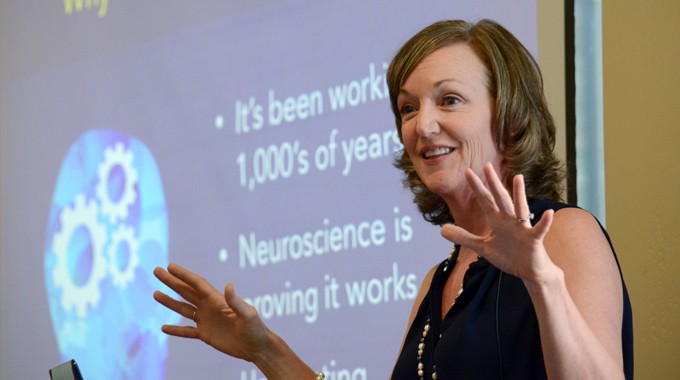
Karen Duggan (pictured) is the owner of The MindWorks Company, a consultancy dedicated to individual and team development, and is currently in the Master of Science in Organization Development program at Pepperdine University. She recently presented an Insight Studio workshop on Mindfulness.