
We asked each candidate to answer a few questions so that you can know a little more about their priorities. Click on each question to reach the candidate’s answer. See responses from the other candidate: Erica A. Stewart.
Rank the issues in order of importance for our county:
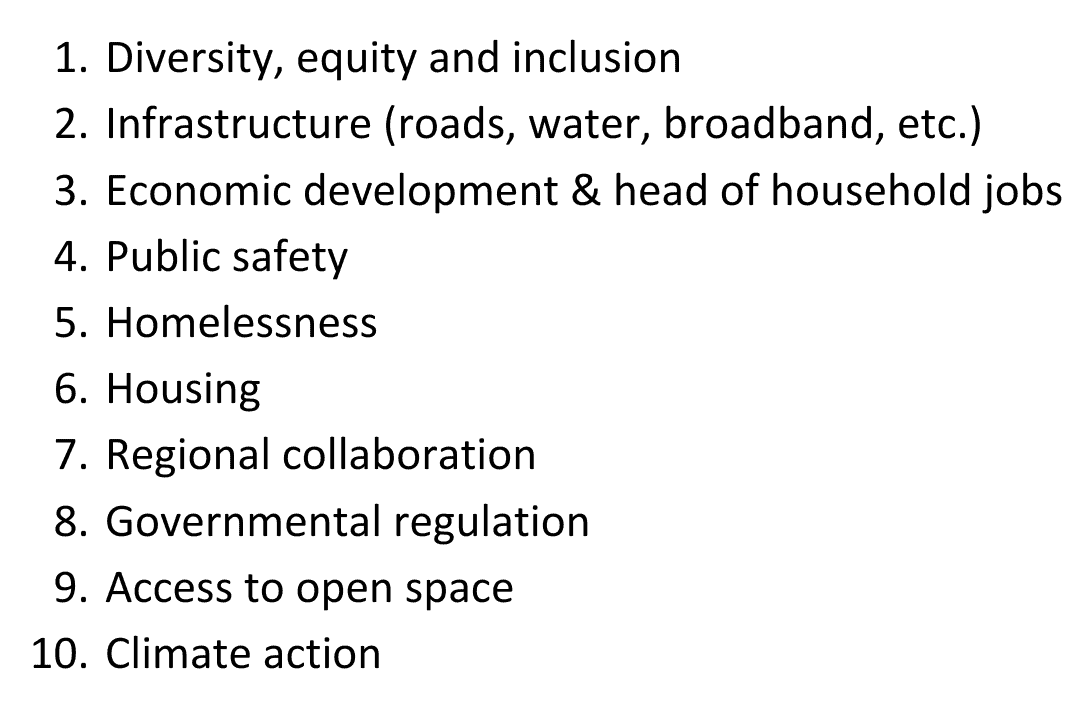
If elected, what will you do to address the issue you identified above as most significant?
I will bring a more diverse view of the issues brought before the council. The apparent goal of discussions being a 5 – 0 vote, in no way embodies diverse opinions. Even the three minutes for public input in the meetings is a blow against inclusion of diversity. Twenty years ago, citizen input was five minutes and I was the first to be cut to three minutes. After I raised a complaint, the time limit was lowered to three minutes for everyone. I have spoke up for the return to the long forsaken five minute speaking limit.
Which theme in the Chamber's regional economic vision, Imagine SLO, do you think deserves the most focus in the next four years and why?
No response given.
What is your approach on traffic and parking issues? Are there any policies that you are committed to advocate for or against?
Parking is a can that usually gets kicked down the road when developments are allowed to limit parking to one vehicle per bedroom, limiting off street parking. In filling of high-density developments, puts even more strain on parking. “Woke” ideas such as separating bicycles from the traffic lanes with redundant curb barriers and redoing the number of lanes, packs more cars into less space. Our old style design of our streets doesn’t work well with “woke” concepts.
For more than ten years, buildings in the downtown core have been allowed to be up to 75 feet tall if they provide significant community benefits; do you support these current regulations? Why or why not?
The new shift to taller buildings with no setback from the sidewalk is turning the streets into dark canyons, obscuring the view of nearby majestic hills that surround our town. We used to be a town that was proud of our historic mission and old buildings that represented the diverse periods of the town’s history. Nowadays, the cramming of big city-style assorted boxes infilling every gap in the neighborhood is destroying the character and appeal of our town.
For the first time in decades, the City is approaching our self-imposed 1% limit on new housing development. Would you support amending this 1% cap to address our housing crisis or do you believe it is essential to maintain this limit?
The 1% limit is a pressure to build bigger developments with too many oversized homes with the intent to draw in more people moving out of the big cities and bringing in their big city economy earnings. The local people that have had to make do with less income from the small town economy, are settling for less money for living the SLO life and now have to compete in an unaffordable housing environment.
What are you most proud of having contributed to our community in the past ten years?
I have become a harbinger of forecasting coming issues being dealt with in public meetings. I have warned people of the special interest groups that have dominated the development of our town. It seems that the town’s management has been selling out our town’s progress to the big money developers and bending over backwards in the process, giving in to corruption. We live in a gem of a town and we should not have to give away so many incentives to sweeten development deals.
What is the biggest opportunity for our City in the next four years?
We need to root out the corruption that is infecting our society from the top down. I could be an opportunity to decentralize and shift more control back to the people. Too much influence from the State and Nation are dominating our local conditions. We need our local control, not universal mandates from big government. We need to return to another original voting system with honestly.
Is there something the City is not currently focused on that you would bring to the forefront if elected?
Electricity! The grid is obsolete and doomed to catastrophic failure. Electric cars are overwhelming the ability to supply enough. The future could be better served if the electric system was turned upside down. By making every roof a solar panel and every building have a battery and every neighborhood have shipping containers sized batteries and have batteries at every substation, feeding back into the grid, the grid could be a source of income for houses and businesses. We would not need as many generating plants. The power would be sourced locally, cars would be locally charged and the power would first be used for local industry. What is left over would be sold to the grid. The system would be less strained and sustainable.