

We asked each candidate to answer a few questions so that you can know a little more about their priorities. Click on each question to reach the candidate’s answer. See responses from other candidates: Mike Boswell, John Drake.
Rank the issues in order of importance for our county:
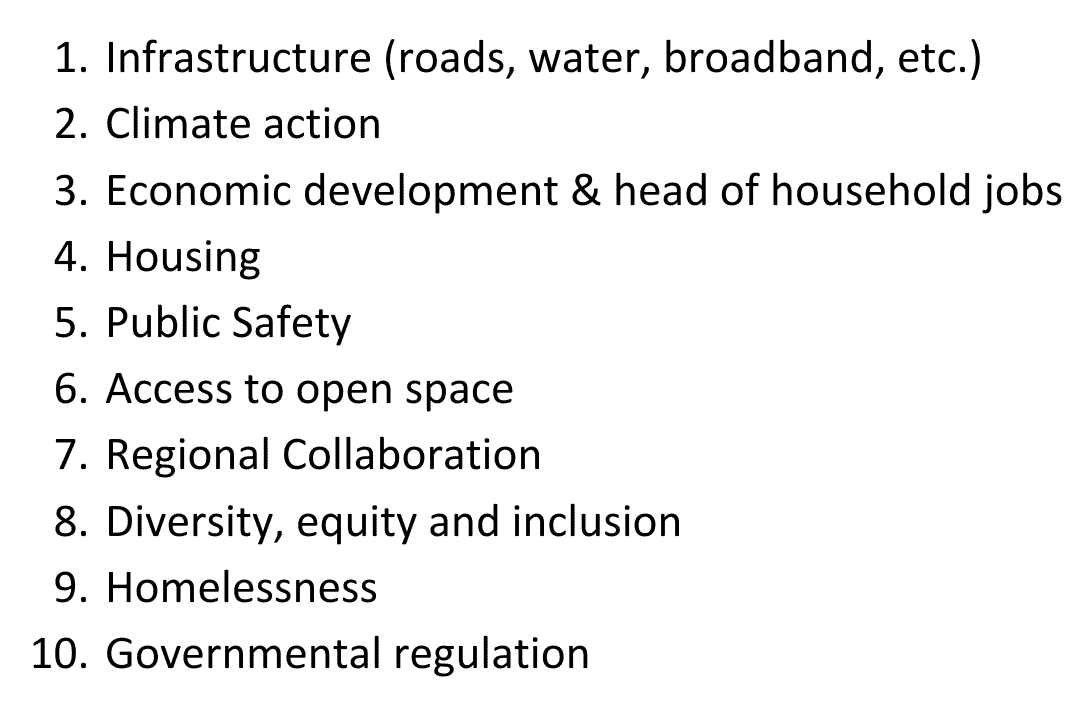
If elected, what will you do to address the issue you identified above as most significant?
The core function of city government is to protect the health, safety and wellbeing of people who live, work or visit our city. So, basic services like water and sewer and road infrastructure must be maintained and improved. Preservation of open space, the urban forest and recreational opportunities, alternate transportation, flood protection and investing in infrastructure that will foster economic development are all crucial. Droughts will recur so we must keep working to make SLO water secure, including making reused water potable, storing reused water underground and providing recycled water to older parts of the city. To increase resilience in the face of natural disaster and/or pandemic, we must expand broadband access, and increase EV charging stations, solar and community battery storage capacity.
Which theme in the Chamber's regional economic vision, Imagine SLO, do you think deserves the most focus in the next four years and why?
SLO City should focus on Environmental Stewardship and embracing new technologies now, more than ever. Given Climate Change, our quality of life depends on protecting and preserving our natural resources, including open space, air quality, and clean water. Encouraging more renewable energy projects not only protects the environment, but also creates head of household jobs. SLO should work harder to become a net zero City, facilitate microgrids and create incentives for electric cars and bicycles, storage batteries and charging stations. The City must do all it can to protect residents against blackouts, given increasing dependence on air conditioning and the internet.
What is your approach on traffic and parking issues? Are there any policies that you are committed to advocate for or against?
I advocate alternative transportation strategies and housing that give priority to people living or working here. These approaches hopefully reduce traffic and parking environmental impacts by reducing automobile commuting. Bike paths are important, however better planning of armored bike paths could have avoided unintended consequences like disabled and senior drivers having to exit cars into oncoming traffic or problems for service vehicles accessing impacted neighborhoods. When cars trying to exit the 101 at LOVR were dangerously lined up on the shoulder, I helped secure funding for the then new LOVR interchange. I support the construction of the Prado Road Overpass to improve East-West circulation and reduce random surface street driving around. I advocate parking structures outside the Downtown core. I voted the Cultural Arts District parking and SLO REP theatre structure.
For more than ten years, buildings in the downtown core have been allowed to be up to 75 feet tall if they provide significant community benefits; do you support these current regulations? Why or why not?
I am opposed to “canyonization” of our Downtown. However, if the occasional taller building is architecturally compatible with historic surroundings, creative, environmentally sound, does not destroy important views, and provides needed affordable housing, height flexibility could be a plus.
For the first time in decades, the City is approaching our self-imposed 1% limit on new housing development. Would you support amending this 1% cap to address our housing crisis or do you believe it is essential to maintain this limit?
The purpose of the City’s Managed Growth Ordinance is to assure that the rate of growth does not exceed natural resource availability and that the provision of municipals services, such as water, sewer and public safety can keep up with new developments. Also, there is no cap on ADU’s or on affordable housing, which is our greatest housing need. Under Municipal code 17.144.010 “Dwellings affordable and enforceably restricted to residents with extremely low, very low, low, or moderate incomes, as defined in the city’s general plan housing element, new dwellings in the Downtown Core, and legally established accessory dwelling units shall be exempt from these regulations.”
What are you most proud of having contributed to our community in the past ten years?
This is my 16th year of serving on SLO City Council. As Mayor 2014-2016 and Council Member 2020-2024, I am glad to have: implemented the first and updated Climate Action Plan, protected more open space; facilitated workforce and affordable housing in San Luis Ranch, Avila Ranch, Righetti and the Margarita Area; advocated for Measure G, the half-cent sales tax measure, payed down unfunded pension liability, and kept the City and businesses on track financially during the pandemic. As President of the Integrated Waste Management Authority, I oversaw the return of the County to the IWMA. I am the Vice President of the Air Pollution Control District, which is making progress controlling dust emissions on the Nipomo Mesa. I also serve on Central Coast Community Energy Policy Board representing SLO and Morro Bay. When not Council from 2016-2020, I served as Dean of the San Luis Obispo College of Law and taught Constitutional Law. I volunteered for City Farm SLO and 40 Prado. Over the past ten years, I’ve responded decisively and creatively to challenges, including the pandemic, economic downturn and disasters such as the pandemic, flooding and drought. I prioritize fiscal responsibility, housing, economic vitality, social fairness, environmental stewardship, neighborhood safety and climate action.
What is the biggest opportunity for our City in the next four years?
The opportunities arising from SLO’s new neighborhoods and new residents also present challenges. During COVID, when people learned that they could live here and work remotely, many diverse newcomers joined our community, often moving into brand new neighborhoods. We have the opportunity to welcome them into SLO, help them make friends and learn about our historical roots and special sense of local identity. We also have a chance to benefit from the fact that they bring “fresh eyes” and new energy to our community. The pandemic revealed the mental health and social challenges of forced isolation, as well as our utter dependence on electronic communication and vulnerability to black outs. Now, we must seize the opportunity to facilitate microgrids, affordable, high speed internet, and green technology, citywide. The next four years are a time of healing, renewal and working together to make our city even more exceptional.
Is there something the City is not currently focused on that you would bring to the forefront if elected?
The City needs to focus on dealing with the upcoming unpredictable cycles of drought and flooding of climate change. When the reservoirs are full, perhaps it is tempting to become complacent about our water supply, and even contemplate selling excess recycled water beyond our urban reserve line to the highest bidder. Instead, we should invest in the infrastructure needed to get recycled water to the northerly, older parts of the City and possibly even to Cal Poly. These areas do not have the benefit of using recycled water, which is cheaper than potable. The City should drill well fields, which function like manmade aquifers, and inject recycled and possibly excess flood water into them for future use. If we go back to utilizing our groundwater in a drought as in the past, we risk causing subsidence like that which destroyed businesses on Los Osos Valley Road.