
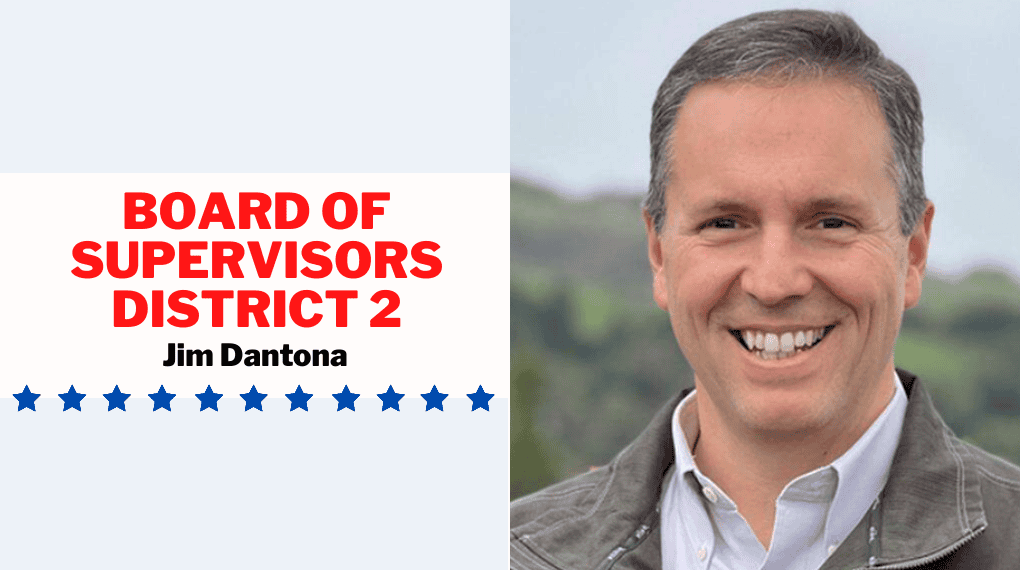
We asked each candidate to answer a few questions so that you can know a little more about their priorities. Click on each question to reach the candidate’s answer. See responses from other candidates: Michael Erin Woody.
Candidate Statement
Jim Dantona has spent half his career in the private sector working in management and accounting, and the other half serving constituents as Chief of Staff and Planning Director for local elected leaders. Most recently, he served seven years as President/CEO of the SLO Chamber of Commerce, where he continued the chamber’s decades-long advocacy for advancing its economic vision of addressing housing and building the foundations of a healthy, thriving local economy while protecting the environment. Having heard firsthand from business owners about the challenges they face during his time at the SLO Chamber, Jim is seeking a seat on the County Board of Supervisors to bring those perspectives into elected office. Jim is proud to have the endorsements of retiring 2nd District Supervisor Bruce Gibson, Congressmen Salud Carbajal and Jimmy Panetta, Assemblymember Dawn Addis, 3rd District Supervisor Dawn Ortiz-Legg, and San Luis Obispo Mayor Erica Stewart, among others.
Rank the issues in order of importance for our county:
- Housing
- Infrastructure (roads, water, broadband, etc.)
- Economic recovery & head of household jobs
- Homelessness
- Public safety
- Government regulation
- Climate action & resilience
- Regional collaboration
- Public health
- Diversity, equity and inclusion
- Taxes
If elected, what will you do to address the issue you identified above as most significant?
I’ve spent half my career inside local government and seen how red tape at all levels of government have constrained our ability to produce housing. My real-world professional experience with government, having worked directly with those responsible for creating housing, will help me limit the impediments to creating housing and the increased costs those impediments cause. Most newly elected officials do not have experience with the inner workings of the governmental processes they oversee. I do. It allows me to give direction that can be implemented. Additionally, as we update our community plans, we need to utilize programmatic EIRs that will cover the implementation of that plan update and not require individual EIRs on every project. This way we can consider the overall impact of the plan together with applicants and stakeholders to apply mitigations that will be known from the beginning as opposed to being applied haphazard and unevenly.
Which theme in the Chamber's regional economic vision, Imagine SLO, do you think deserves the most focus in the next four years and why?
“We Before Me” has always been the pillar of the Imagine SLO economic vision that I have thought is most important for our county and our region. We are one of the smaller counties in California. If each community in our county tries to go it alone, we’ll fail. Whether we’re discussing our housing plans, our infrastructure or our economy, we need to work together. For example, our county has dozens of different water agencies, three different homeless services organizations, and nine different chambers of commerce. We should work together to meet the needs of our community and not spend duplicative energy on all our tasks. Since we have a smaller population than many larger counties, we need to be efficient in everything we work on to ensure long-term success.
What are you most proud of having contributed to our community in the past ten years?
I’m proud of the work I did leading the SLO Chamber of Commerce. During the seven years I served in the chamber, our community and economy faced immense challenges: The pandemic, dependent care pressures, and the shutdown of Diablo Canyon. Whether it was the chamber’s work with the City of SLO to build the Buy Local Bonus program during the pandemic to support our local business community, working with First 5 to develop the Family Friendly Workplace Program to meet the challenge of our childcare crisis, or engaging with all our community partners to support the extension of Diablo Canyon to ensure a stable electric grid into the future, I’m proud of the work our chamber team did to meet those challenges and build the foundations for continued community success.
What is the biggest opportunity for the County as a whole in the next four years?
Our county’s biggest opportunity is economic, focused around future-forward industry sectors. With the expertise being created through the education our students are receiving at Cal Poly and Cuesta College, our community could see tremendous growth in precision manufacturing, aerospace and ag technology. These sectors will bring good paying jobs that will allow our next generation the ability to make San Luis Obispo County their home and ensure that our county continues to thrive into the coming decades. We can only capture this opportunity if we meet the housing, healthcare and infrastructure demands to allow that investment in our community. As Supervisor, I’ll prioritize the work that will ensure we capture that opportunity and continue to maintain the quality of life we enjoy.
Is there something the County is not currently focused on that you would bring to the forefront if elected?
The county is focusing on homelessness, but I don’t believe we’re prioritizing it enough to truly turn the tide on this problem. While there isn’t a silver bullet to help deal with this crisis, our county has an inefficient, scatter-shot approach. We distribute funding in smaller amounts to many organizations, but we should focus our investment on fewer, specific proven successes. While our homeless issue feels large, we can still make an impact and bring coordinated solutions – but the time to act is now. For the sake of people’s humanity and the safety of our communities, we can’t let this issue continue. San Luis Obispo County government should be the hub for the entire county to bring everyone together to coordinate solutions. I look forward to working with our governmental agencies and service partners to make this response more effective than it is today.
Do you think our business environment is healthy? If not, what would you do to change that?
I believe we can have a healthy business environment, but we need to take certain steps to make it truly healthy. A healthy business environment is more than producing enough revenue for our businesses, but also a workforce that meets the needs of our businesses. We need to ensure employees can live in or near the communities where they work or we’ll be left with stifling traffic. Employees with families need to find affordable childcare to make work financially feasible and not add to the stress of meeting their family needs. The threat of a workforce that cannot find either of those things means our businesses won’t be able to thrive and will look to move to places where their workforce will. As Supervisors, we must plan and invest effectively to meet this challenge. It’s possible if we all work together.