

April Esser, The Mountain Air
What is it about the company, Patagonia, that makes a group of business owners and entrepreneurs wake up an hour before the sun, climb into a bus, and take the two hour ride down to Ventura, just to get an inside look at the company and their facility? You might think it’s merely the fact that Patagonia is a successful company, and sure, they are a business that continues to grow with a reputation for high-quality products and profound innovation; however, there is something that separates Patagonia from other successful gear and clothing companies.
This difference is Patagonia’s genuine connection to the environment, their employees, their supply chain, their user base and their products, and the fact that they truly care about the impact the company has on each of these different areas.
- Patagonia’s connection to the environment is no “Go Green” gimmick; it has been there from the beginning. Even before the company Patagonia existed, Yvon Chouinard cared equally, if not more, about preserving the environment than he did about profit. Even though today Patagonia is a worldwide company, it can be seen in their actions that this method of business is still true. For example, when Patagonia came out with a new wetsuit design called Yulex (made from the guayule plant instead of the typical petroleum based design), rather than keeping this new technology to themselves, they left the design patent open. They have done this with multiple different environmental product designs in hopes that other companies will adopt the new methods and help make a greater impact in protecting the environment. Patagonia also turned down the idea of adding a layer of thin metal into a down jacket to make the jacket warmer. They acknowledged the reality that in order to make this jacket, it would cause mining for the metal to occur. When they weighed out the value of the enhancement of the product, versus the harm to the environment, they decided that the added warmth to the jacket was not significant enough for them to support the mining of the metal, and so the idea was dropped.
- When you first arrive at Patagonia, you see the spectacular play area outside of the Patagonia daycare center. This daycare center is one of many representations of how well Patagonia cares for their employees. All employees’ children can attend the daycare, and if they need to be taken to school or picked up, there are people on Patagonia’s payroll to do this. Not only that, but parents are allowed to take their children on trips when they need to travel for business! It is obvious that family is very important to the company.
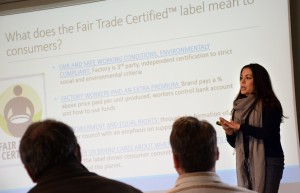 Within the last few years, Patagonia has begun pushing to get all of their clothes produced with a Fair Trade Certification. Each year, the amount of their products produced with this certification multiplies. The certification is only given to products that are made in a facility that pays their workers livable wages, and though the Fair Trade Certification is typically more common in the food industry, Patagonia is one of the first big brand clothing companies to seek out this certification.

- Patagonia’s new program, Worn Wear, connects the company with longtime users of the brand. This program allows people to send in their old, used, torn gear or clothing to have it fixed. They have also begun touring the country in two biodiesel trucks teaching people how to fix their own gear, selling used gear, and sharing beer and movies with people across the country. Their goal is to promote repairing and reusing old clothing in fun, friendly way that connects the company with the community.
- This brings me to my last takeaway from my tour of Patagonia. That is the gear and products themselves. They are designed as functional and as art, so that they do what they need to do and they don’t go out of style. Patagonia intends to make products that last a lifetime and encourages the lifestyle opposite of what many other businesses push; they promote a lifestyle that breaks free from consumerism and promotes living simply and with only what you truly need.
On April 20 the SLO Chamber took a group of local business people to tour Patagonia’s headquarters in Ventura as part of the Chambers ever-growing efforts to support and inspire green business practices.
April Esser is a sales associate at The Mountain Air in San Luis Obispo and a communications major at Cal Poly.