
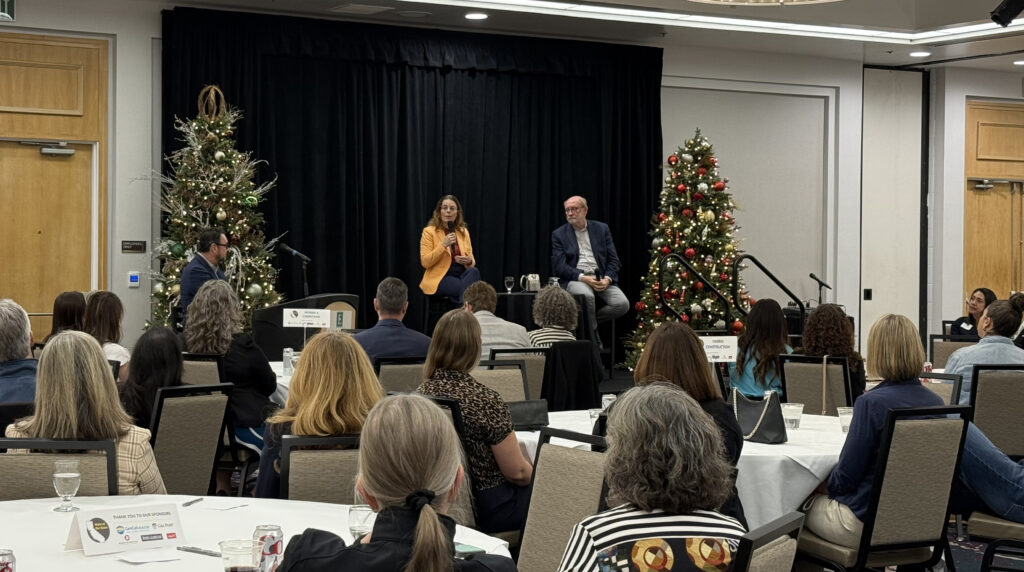
The SLO Chamber’s annual State of the State dove into the critical issues shaping the Central Coast’s economic future. Featuring Senator John Laird and Assemblymember Dawn Addis, and moderated by John Myers of CalChamber, the discussion confronted how national and state-level policy shifts and political tensions intersect with the everyday realities of local employers and residents.
Healthcare is a major economic concern for the Central Coast. Federal uncertainty around Affordable Care Act subsidies and public health funding is impacting clinics, hospitals and insurers, which anchor jobs and provide essential care access for entire communities. When coverage becomes unstable, employers face workforce disruptions, higher uncompensated-care costs and greater financial volatility. Assemblymember Dawn Addis described the current moment as “visceral,” reflecting how deeply health care coverage ties into both household and employer stability in the region.
Increased immigration enforcement is heavily impacting our workforce and labor pool. Agriculture, hospitality, healthcare and manufacturing industries on the Central Coast all rely on predictable labor pipelines with a consistent employee pool. Changes to federal immigration policy, visa delays and enforcement have ripped through local businesses, impacting everything from harvest schedules to hospitality staffing. Senator John Laird noted that workforce shortages due to increased immigration enforcement have literally left “crops staying in the field,” while Addis emphasized that a strong regional economy depends on “people being able to work safely and legally.”
Affordability continues to be a major challenge for residents and employers alike. Housing, utilities and everyday costs consistently outpace wages, limiting the ability of Central Coast communities to attract and retain workers. State-level cost-relief measures, including expanding access to essential medications and accelerating renewable energy projects, are increasingly recognized as tools to retain a reliable workforce. Increased costs of home insurance, due to a higher likelihood of fire or natural disaster, are reshaping household budgets and business planning, placing a higher cost burden on people and leaving less room for discretionary spending.
In addition to these cost pressures, legislation that supports our local economy remains critical for our region’s economic stability. Both Addis and Laird agreed that if PG&E continues to operate at Diablo Canyon, the unitary tax needs to be reinstated, which provides significant financial support to our local schools. Laird noted that he is actively working on a legislative fix to reinstate the unitary tax and help our county receive the funds.
As federal and state financial support tightens, self-help measures and regional collaboration are more critical than ever to continue to maintain essential services and keep our Central Coast thriving. Early collaboration on infrastructure projects and permitting processes will continue to be key in avoiding costly delays in housing development. Senator Laird highlighted legislation he introduced to provide a pathway to self-help infrastructure funding in San Luis Obispo County, allowing the voters to decide on raising the local sales tax rate above the state cap to fund transportation infrastructure. The San Luis Obispo Council of Governments (SLOCOG) has been leading the effort to produce a balanced assessment of the county’s transportation infrastructure and the impact a self-help tax may have on communities throughout SLO County.
Despite the challenges many face in these trying times, there are reasons to be optimistic. Senator Laird emphasized that when constituents bring issues directly to him, it creates opportunities for real solutions, such as reducing out-of-pocket health care costs for services not covered by insurance, a change sparked by a single conversation. Assemblymember Addis underscored the strength of local networks, from volunteers to schools stepping up during times of crisis. “Change can be slow and incremental, but it does happen,” she reminded the audience.
The SLO Chamber works tirelessly on behalf of you, our business community, to navigate these challenges head-on. We engage early in policy conversations and advocate for more housing, infrastructure, and climate-resilient policies to secure the region’s long-term vitality. But this work is most effective when we do it together. Get involved by joining a Chamber committee, attending our legislative events, giving public input at City Council and County Board of Supervisors meetings, and sharing your insights with our team. The work the Chamber does to better our region is fueled by your business and your voice, and we’re committed to keep showing up on your behalf and working to ensure the Central Coast continues to thrive.