
The growing number of companies setting up shop in San Luis Obispo bring with them a number of community benefits: head-of-household jobs, increased employment options, and more tax revenue that helps pay for infrastructure upgrades, services, local schools and programs, among others.
Of course, along with these benefits comes the challenge of balancing an increasing need for diverse housing options with water conservation in the fourth year of a drought.
Thanks in part to forethought, planning, information gathering and a lot of education; San Luis Obispo is in a safe position to deliver.
There are currently more than 45 development projects slated for San Luis Obispo. The projects, to be developed over the next several years, will provide much needed housing and commercial space built with much higher and more efficient environmental standards than currently exists.
In August 2012, a year after the State adopted the California Green Building Standards Code (CALGreen) requiring more water efficiency in new construction projects, San Luis Obispo released its Climate Action Plan aimed at outlining, among other things, water usage and conservation for existing structures and new developments in the City.
The plan set in place strategies for water conservation, requirements for water-efficient construction and landscaping, as well as encouraging the reuse of greywater and rainwater.
More recently, the SLO City Council adopted a Drought Response Strategy in response to Gov. Jerry Brown’s executive order and mandatory reductions required by the State Water Resources Control Board. The strategy includes a deferment of landscape planting or modified landscape plans to significantly reduce water demand for new developments in the city.
Three separate strategies implemented as part of the Climate Action Plan include Water Conservation: Existing Development, Water Conservation: New Development, and Public Outreach and Education.
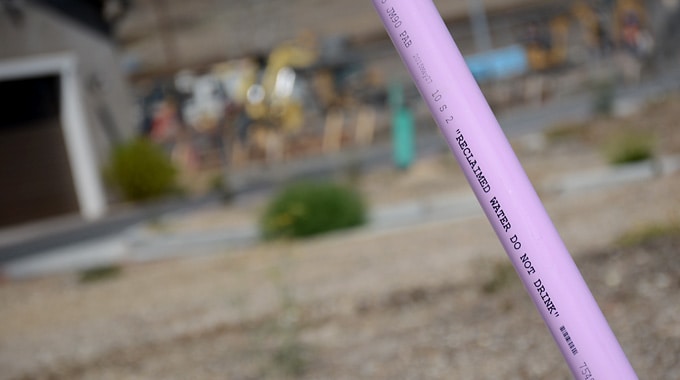
Strategies implemented through the plan for new developments all meet CALGreen standards and are heavily focused on the expansion of recycled water infrastructure, also known as “purple pipe”, to encourage the use of recycled water in construction and landscape projects. Other requirements include the installation of water efficient fixtures or, through alternative methods, a 20 percent reduction in water use. The requirement to use native and non-invasive drought tolerant plant materials and landscape designs that prevent run-off are also included.
The recent approval of a couple of major developments in the city, including the 150-acre Avila Ranch and the 131-acre San Luis Ranch projects, have brought an expansion of recycled water infrastructure as developers are planning and laying down purple piping in many of the new projects.
The City of SLO has been using recycled water for irrigation purposes since 2006. Currently many parks, Laguna Lake Municipal Golf Course and a number of condo complexes are watered using recycled water.
The segment of the Climate Action Plan outlining strategies for existing developments mainly focuses on landscape projects that trigger a building permit review. It includes requirements to incorporate native and drought-tolerant plant materials to minimize irrigated turf areas, incorporate irrigation systems to avoid runoff, and to encourage the use of recycled water, greywater or rainwater.
Alongside the water savings are the overall environmental benefits of decreased greenhouse gas emissions that come along with living in close proximity to work, shopping and entertainment hubs. Combined with the choices residents and commuters make on how they get to and from their destinations, the overall quality of life improves for the local community as well as the increased protection of our natural environment for generations to come.
Current Water Usage
As a community, San Luis Obispo uses 108 gallons of water per person per day. Under the state water regulations, San Luis Obispo must cut its water use by 12 percent, to 101 gallons per person per day, as compared to 2013. According to a report of water usage in June of this year released by the State Water Resources Control Board, SLO residents used 60.6 gallons per person per day, an 18 percent reduction from June 2013.